
$1 Coin Value Chart: Top 5 Australian One-Dollar Coins Worth Checking
$1 coin value chart searches usually begin with one simple idea: maybe one Australian dollar coin is worth more than face value. That idea is sometimes right. Most Australian $1 coins are ordinary circulation pieces. A smaller group stands out because of a major error, a much lower mintage, a letter subtype, or a scarce privy-mark issue. Those are the coins worth checking first.
Do not think that every Australian $1 as a rarity. So, here we would like to discuss five coins that give collectors a real reason to look closer.
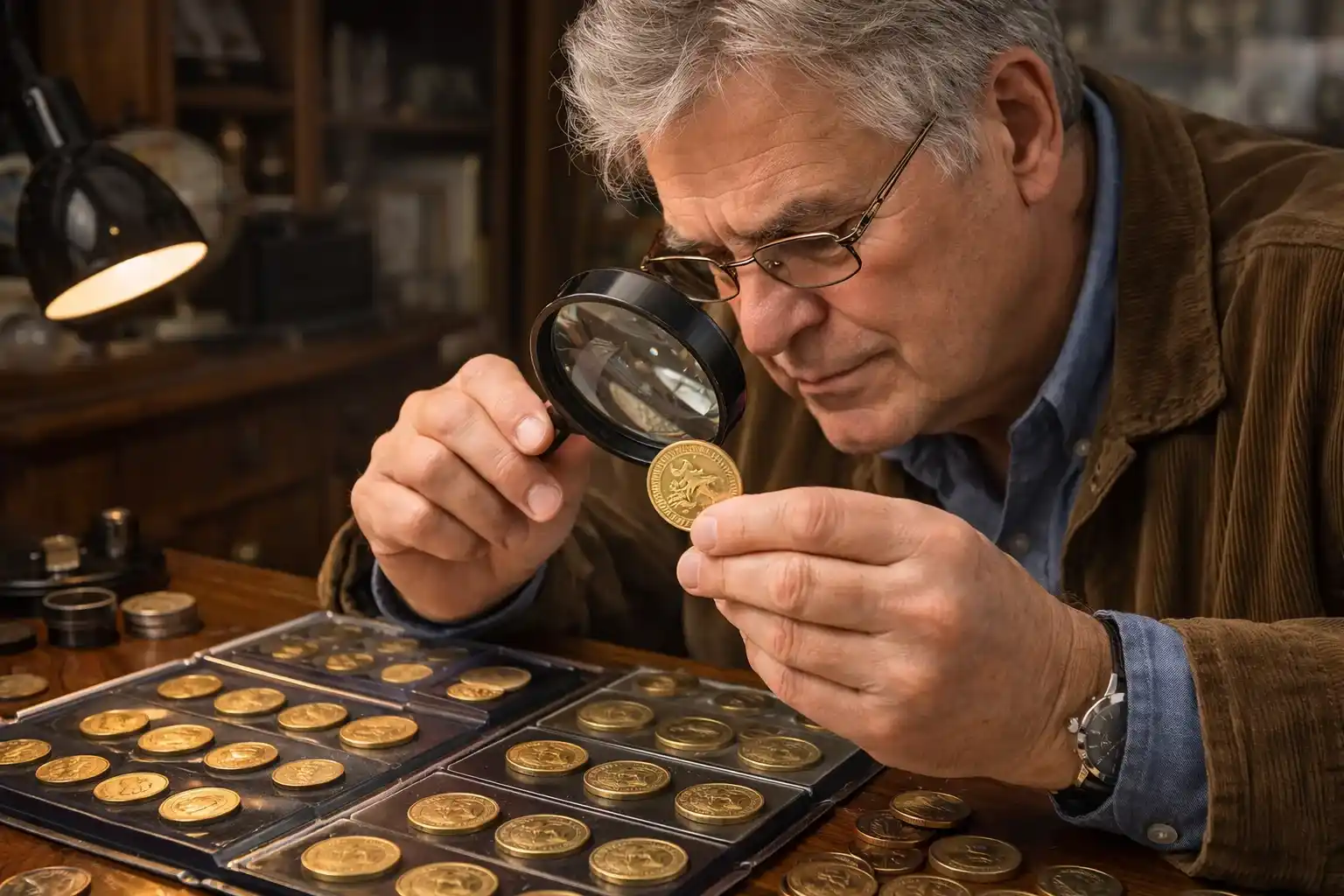
What Makes an Australian $1 Coin Worth Checking?
The Australian one-dollar coin is not a silver coin. The Royal Australian Mint lists the standard composition as 92% copper, 6% aluminium, and 2% nickel, with a mass of 9.00 grams, a diameter of 25.00 millimetres, and an interrupted milled edge. That means metal value is not the reason these coins become interesting. Collector value usually comes from something else.
For this series, the main value drivers are easy to name:
- A recognised error
- A much lower official mintage
- A special subtype, letter, or privy mark
- Stronger preservation
- Steady collector demand
That is why an article about Australian $1 coins should not read like a simple date list. Many dates are common. Some commemoratives are common too. The pieces worth checking are the ones where the market has a clear reason to care.
Quick $1 Coin Value Chart: Top 5 Coins Worth Checking
The chart below is a practical guide, not a strict auction ranking. It mixes one major error with four issues that stand out by official mintage or subtype status.
| Coin | Why it matters | Official mintage/status | What to check first | Value direction |
| 2000 $1 Mule Error | major recognised mule error | error coin, quantity unknown; PCGS says no more than about 20,000 pieces are estimated | full double rim around the whole obverse | far above face value; lower grades often in the hundreds |
| 1992 Mob of Roos | unusually low official mintage for standard design | 0.008 million | correct standard five-kangaroo design and date | collector premium above ordinary dollars |
| 2016 Decimal Anniversary Obverse | much lower mintage than the standard 2016 dollar | 0.56 million | anniversary obverse, not normal standard type | stronger interest than the regular 2016 dollar |
| 2019 Dollar Discovery “A” | letter subtype with lower mintage than standard issues | 1.513 million | “A” letter in the design | collected as part of the Dollar Discovery set |
| 2019 Great Aussie Coin Hunt “A” Envelope Privy | very small official mintage | 0.0145 million | envelope privy mark and correct “A for Australia Post” type | clear collector premium for the right subtype |
This chart shows an important split. The 2000 mule belongs in an error-coin market. The other four belong in a mintage-and-subtype market. They are not equal in price, but they are equal in one practical way: each gives a collector a reason to stop and check the coin more carefully.
A coin value checker fits best at this stage of the process. Not as a substitute for grading, and not as a final judge on rarity. On a series with standard designs, commemoratives, letter issues, and privy-mark subtypes, it helps keep coin cards, saved examples, and side-by-side comparisons in one place while you sort out what you actually have.
2000 $1 Mule Error: The One Everyone Still Checks
This is the best-known valuable Australian $1 coin. PCGS describes it clearly: the coin was struck with the reverse of a $1 coin and the obverse of a 10-cent coin. That is why it is called a mule. It is a recognised modern Australian error, not a rumour and not a social-media myth.
The key marker is simple. The dies of the 10-cent coin are slightly smaller than the collar used for the $1 coin. When the coin was struck, that mismatch created an outer rim. On the obverse, the effect appears as a pair of concentric circles around the full circumference.
PCGS also warns that collectors should not confuse this with a minor off-center effect, where a double-rim look appears only on part of the coin. On a true mule, the double rim runs all the way around.
Why does this coin matter so much? Because it combines three things at once:
- It is a major error
- It entered circulation
- It is easy to explain and easy to chase.
PCGS says the number released is unknown, but numismatic experts estimate no more than about 20,000 pieces exist, most in circulated grades. It also says circulated examples once sold for over A$1,000, but lower and middle grades now usually sell for only a few hundred dollars because more worn pieces kept turning up in change. That still places the coin far above face value and far above normal circulation dollars.
1992 Mob of Roos: The Low-Mintage Standard Issue
The 1992 standard Mob of Roos dollar is one of the most unusual entries in the official Royal Australian Mint mintage table. RAM lists the standard five-kangaroo design for 1992 at 0.008 million, or 8,000 coins. That makes it one of the smallest official figures in the main one-dollar series.
That number alone makes the coin worth checking. It is not a dramatic error. It is not a flashy commemorative. It is a standard design dollar with an official mintage that looks very different from the large figures seen for 1984, 1985, or many later years. RAM also notes that no one-dollar coins were produced in 1989, 1990, or 1991, which makes the 1992 return of the standard type even more noticeable.
This is where collectors need some caution. A low mintage helps, but it does not turn every coin into a headline rarity in every grade. Preservation still matters. Market demand still matters. The main point is simpler: if you find a normal 1992 Mob of Roos dollar, it is one of the first standard dates in the series worth checking more closely.
2016 Decimal Anniversary Obverse: The Number Collectors Notice
The 2016 one-dollar series gives a very good lesson in why subtype matters. On the Royal Australian Mint page, the normal 2016 five-kangaroo dollar is listed at 30.2 million. On the same page, the special 2016 obverse design for the 50th anniversary of decimal currency is listed at 0.56 million. That is a very large gap within one calendar year.
That is why this coin belongs in a practical top five. It shows how a modern Australian dollar can shift from ordinary to collectible without changing denomination or composition. The standard 2016 coin is common. The anniversary obverse is not in the same lane.
A quick comparison makes the point:
- 2016 standard $1: 30.2 million;
- 2016 anniversary obverse $1: 0.56 million.
Collectors do not keep this coin because it is old. They keep it because the subtype stands apart on official production figures. On a modern series with many millions of ordinary pieces, a 560,000-coin issue is enough to attract attention.
2019 Dollar Discovery “A”: A Modern Letter Coin With Real Appeal
The 2019 Dollar Discovery coins were issued to mark 35 years of the Australian $1 coin. Royal Australian Mint lists three letters in this group: S, U, and A. The “A” coin is listed at 1.513 million, while the “S” and “U” coins are each listed at 1.512 million. Those are not tiny numbers in absolute terms, but they are much smaller than the ordinary 2019 standard dollars listed on the same page.
This issue matters because it shows another kind of collector interest. The value does not come from an error. It does not come from silver. It comes from subtype collecting. People look for the letters as a set. That keeps the “A” coin relevant even though it is a modern circulation-era issue.
The “A” is also a good example of a coin that many casual users might miss. At a glance, it is still a modern dollar. To a collector building the 35th-anniversary letter group, it is a target coin, not a pocket-change duplicate.
2019 Great Aussie Coin Hunt “A” Envelope Privy Mark: Small Numbers, Strong Attention
This is the narrowest and most specialised coin in the top five. On the Royal Australian Mint page for the Great Aussie Coin Hunt 1 program, the A for Australia Post – Envelope Privy Mark coin is listed at 0.0145 million, or 14,500 pieces. On the same page, the standard A for Australia Post coin is listed at 0.523 million. That difference is exactly why the envelope-privy version stands out.
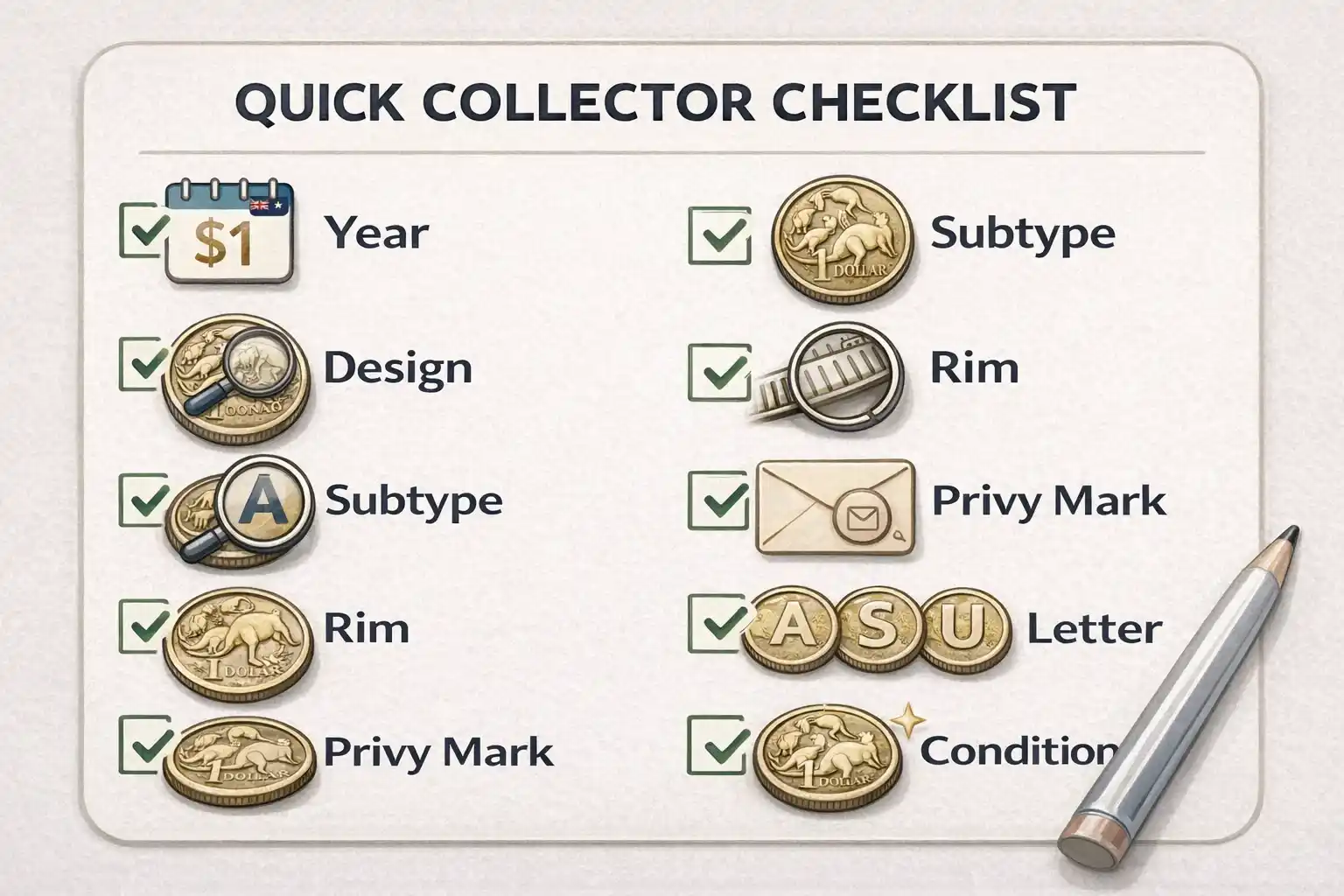
This is not a coin to judge by date alone. The date is 2019. That is not enough. The subtype is the whole point. A collector has to check three things:
- It is the “A for Australia Post” type
- It has the envelope privy mark
- It is not the standard 0.523-million version
For modern Australian collectors, this kind of coin matters because it sits at the intersection of themed collecting and low mintage. It is not a classic old rarity. It is a targeted modern issue with small official numbers and a clear identity. That is often enough to create a stronger collector premium than the public expects from a recent one-dollar coin.
Why Some Australian $1 Coins Stay Cheap
This part matters just as much as the top five. Many Australian $1 coins stay close to face value because the market has no special reason to move them higher. The Royal Australian Mint one-dollar mintage page is full of large figures. The standard 1984 coin was issued at 186.3 million. The 1985 coin was 96.2 million. Many later standard or commemorative issues are also large.
A coin usually stays cheap for one of four reasons:
- big mintage
- no recognized error
- no special subtype
- ordinary circulated condition
That is why “commemorative” does not automatically mean valuable. A special design can still be common. A modern coin can still be ordinary. The collector should always ask what the real driver is: error, mintage, subtype, grade, or demand. If none of those is strong, the coin usually remains a normal dollar.
FAQs
Are all Australian $1 coins collectible?
Yes, in the broad sense, but not all have a premium. Many are easy to collect. Far fewer are genuinely scarce or strongly chased.
What is the most famous valuable Australian $1 coin?
The 2000 mule error is the best-known example. It has a recognised mint error, a clear visual marker, and a long history of collector demand.
Is a low-mintage coin always expensive?
No. Low mintage helps, but condition and collector demand still decide the final market level.
Are the 2019 letter coins worth keeping?
Yes. The Dollar Discovery “A”, “S”, and “U” coins have smaller mintages than ordinary standard dollars and are collected as a letter set.
How do I tell if a 2000 dollar is a mule?
Check the obverse for a full double rim made of two concentric circles around the entire edge. A partial double rim is not enough.
Which modern Australian $1 coins should I check first?
The 2016 decimal anniversary obverse, the 2019 Dollar Discovery letters, and the 2019 Great Aussie Coin Hunt privy-mark issues are good starting points because their official mintages stand apart from ordinary circulation dollars.
Final Take
Most Australian $1 coins are common. A smaller group deserves a closer look. The 2000 mule stands above the rest. The 1992 Mob of Roos matters because the official number is very low. The 2016 anniversary obverse and the 2019 “A” Dollar Discovery coin show how modern subtypes can attract collectors. The 2019 Great Aussie Coin Hunt “A” envelope privy is another good example of a recent coin with stronger collector interest.
A collector can also use free coin apps such as Coin ID Scanner in a practical way. The app helps keep saved examples together, compare similar dollar subtypes, and organise standard, letter, and privy-mark coins inside one collection.