How a Coin’s Price Changes Based on Mint, Year, and Quantity
The real price of a collectible coin worth money is decided by how unique and scarce it is, not by the metal it contains.
Uniqueness and scarcity depend on production facts, covering the place of striking, the time of striking, and the total number made.
Knowing these three things helps explain why two coins looking the same can have a price difference of hundreds or thousands of dollars.
The Mint Mark
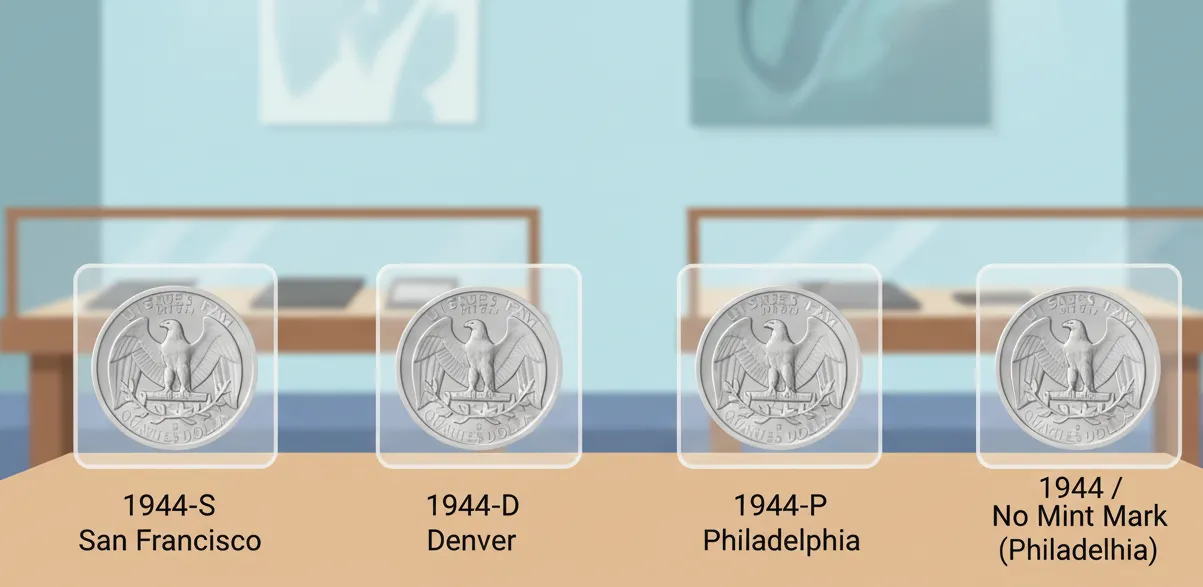
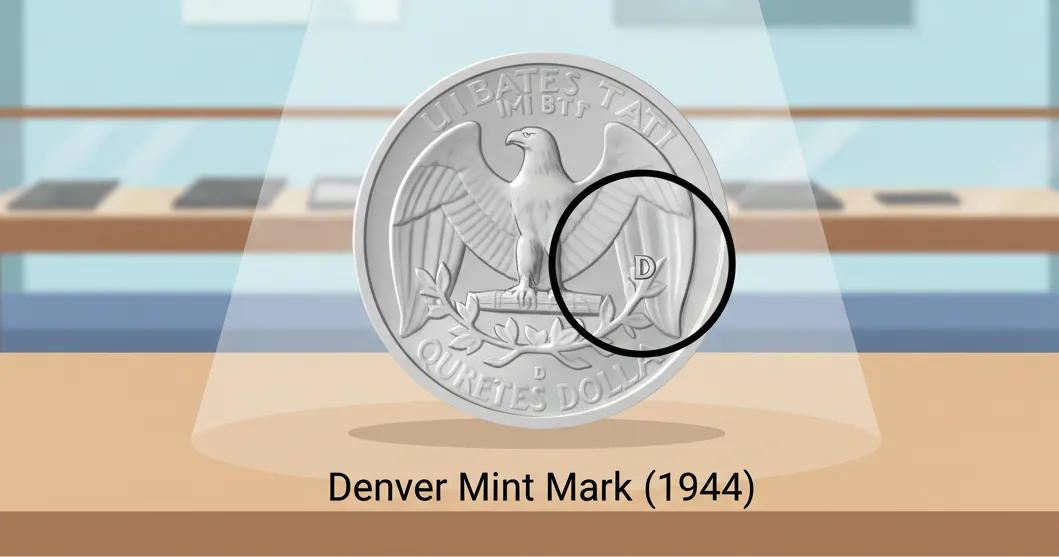
A mint is the government place that makes coins. In the United States, we have big mints like Philadelphia (P) and Denver (D), making many coins. A small letter or symbol, the mint mark, is placed on the coins for easy finding.
Price differences caused by the mint happen for simple reasons:
Different quantities were made.
Often, for the same coin type made in the same year, the total number of pieces made at Mint P and Mint D is not the same.
If Mint P made ten million coins and Mint D made only one hundred thousand, the Mint D coin becomes much scarcer, making it more expensive because it is only a small part of the total run.
Small design differences.
Sometimes, minters use different tools to strike the coins. This can lead to small but notable differences in the picture details, the letters, or the placement of the eagle.
These small versions, known as “die varieties”, are found only on coins from one certain mint, costing more than the normal coin.
Stamping mistakes or test coins.
Sometimes, a mint makes a small number of test coins that were not meant for buying things, or which had special flaws not approved for use.
These coins are usually taken back, but the few coins that get into circulation have a high price. The flaw or difference must be special to that mint and its work process.
The Year of Issue
The year written on the coin shows when it belongs in history. The year changes the coin’s price due to these simple facts:
- In some years, the government chooses to change the metal mix used for coins.
For example, changing from copper-nickel to steel with nickel plating.
Coins made in this change year using the older, more valuable metal mix, but made in a small number, quickly become scarce. Collectors look for just these specific types in the coin scanner.
- Special event or holiday coins are linked to a certain date or event. Their design is unique for only that year. Also, when the country’s emblem or official name changes in certain years, the coins with the old or new design in small numbers become much more valuable, making them desirable for finding.
If making a coin of a certain face value stops in a certain year, the last group of coins from that year might be small.
This is true for coins with a high face value, not used much every day. The most scarce year in a series is often the last year it was made.
- The most valuable coins have years on them when the coin was not officially made for the public.
These could be test coins or samples made but never released because of money or political choices. Their auction price can be huge, showing their extreme scarcity.
Mintage
Mintage is the total number of coins made and released for general use or for collecting. This is the main thing deciding how scarce the coin is.
- Coins made in runs of tens or hundreds of millions are the cheapest. Their price is close to their face value, with only perfect condition coins (Uncirculated, not used) adding some value. Their easy availability stops them from having high numismatic worth.
- These are coins made from tens of thousands to a few hundred thousand pieces. These are often event or holiday coins released in a limited number, but still go into general use. Their price is higher than their face value, growing steadily over time.
- Coins with fewer than ten thousand pieces, and sometimes fewer than one thousand pieces. This includes test coins, coins with errors not fixed before release, or special collector sets never meant for general money use, for example, Proof quality coins sold only to collectors.
It is simple to know that price depends not just on a small run, but on the small run compared to how many people want it.
A coin with a ten-thousand-mintage run that no one wants will be cheap.
However, a coin with a ten-thousand-dollar run having historical worth or belonging to a popular group will cost a lot, causing high demand.
Factors Working Together and Examples
The three facts – mint, year, and mintage – always work together. The most costly coin is the one putting together a rare year, a rare mint, and a small total mintage.
For instance, some modern US pennies from certain years, made only at one mint like San Francisco in a small number, became collection rarities and can be checked with a free coin value app.
Their price is much higher than their face value, while coins from other years of the same type, made in huge numbers at Mint P, sell for face value.
| Denomination | Year | Mint Mark | Estimated Price |
| 1 Cent | 2007 | P | Face Value |
| 1 Cent | 2007 | D | Face Value |
| 1 Cent | 1943 | S (Steel) | Medium (5 – 15 dollars) |
| 5 Cents (Nickel) | 1937 | D (3-Legged) | Extremely High (2,000 – 5,000 dollars) |
| 10 Cents (Dime) | 1982 | P | High (30 – 50 dollars) |
| Quarter (Commemorative) | 2010 | S | Medium (10 – 20 dollars) |
Other Facts Changing the Price
We also look at other simple things that change the final price:
- Coin condition. The level of wear makes a difference. A coin just made (Proof or Uncirculated) costs hundreds of times more than the same coin found on the ground or used a lot. Perfect condition shows the coin is a rare item, avoiding normal wear.
- Presence of errors. Production faults, like a double strike, a turned picture, or being stamped with the wrong metal piece, raise the coin’s price quickly. Only a known and stable error type is valuable for collectors, not simple wear or damage from use.
- Material. Even though metal is not the main thing for rare coins, it matters for the first price. Coins made of gold, silver, or platinum always have a minimum price equal to the metal they contain, determining the lowest possible cost.
So, to find the true price of a coin, one must check its production data: see the mint mark (P, D, S), find the year it was made, and look up the official numbers for the total mintage by that mint in that year.